GEO vs SEO is quickly becoming the most confusing question for business owners trying to stay visible online in 2026. Two years ago, the answer to “how do I rank my website on Google” was straightforward: write good content, build a few backlinks, target the right keywords, and wait. That equation has quietly broken. A client in Kolkata recently told me, “My shop doesn’t even show up when I ask ChatGPT, but I’m on page one of Google” — and that single sentence sums up exactly why this conversation matters right now.
After a decade of working on search strategy for businesses of every size, here’s my honest take: GEO (Generative Engine Optimization) isn’t a passing fad, and it isn’t replacing SEO either. What’s actually happened is that the way people search has fundamentally split into two behaviors — and any Kolkata business that doesn’t understand this shift will spend the next two to three years watching competitors who figured it out first pull ahead.
This isn’t going to be another generic “AI is changing everything” post. Instead, we’ll walk through what the data actually says, which business types should prioritize which strategy, what Google’s latest core updates are rewarding, and how to run both playbooks at once without doubling your workload.
What SEO Actually Is — A Quick Refresher
Search Engine Optimization is the practice of structuring a website so that search engines like Google and Bing can understand it, index it, and rank it for relevant queries. It rests on three pillars:
- Technical SEO — site speed, mobile-friendliness, crawlability, site architecture, Core Web Vitals
- On-page SEO — keyword research, content quality, meta tags, internal linking, heading structure
- Off-page SEO — backlinks, brand mentions, local citations, reviews
How Traditional SEO Actually Works in 2026
One thing needs to be said clearly: Google is still the largest search platform on the planet, and organic ranking remains one of the biggest revenue channels for most businesses. But the surface itself has changed. Search results pages now open with an AI-generated summary sitting above everything else — the AI Overview. Industry tracking shows this feature now appears on roughly half of all tracked search queries as of early 2026, a sharp jump from just a year earlier when coverage was much lower.
What does that mean in practice? Users search, get an answer right at the top of the screen, and often never feel the need to click through to a website at all. This is what’s known as “zero-click search,” and it has spread across nearly every industry. Independent studies have found that organic click-through rates drop noticeably for queries where an AI Overview appears — though brands that are cited within that overview tend to capture a disproportionately large share of the remaining clicks.
Google’s 2026 Core Updates and E-E-A-T — What Matters Most Right Now

In 2024, Google folded its Helpful Content System directly into the core ranking algorithm, meaning it’s no longer a periodic update — it’s a continuous, always-on signal. The March 2026 core update made this even clearer: sites that demonstrated real, first-hand experience saw measurable gains, while sites offering comprehensive but impersonal information — content built on structured data and topical coverage alone, without experiential evidence — saw declines.
This is where the E-E-A-T framework becomes central: Experience, Expertise, Authoritativeness, and Trustworthiness. Google itself has stated that Trust is the single most important of these four pillars. In practical terms, this means keyword density alone doesn’t cut it anymore — your content needs a clear author, real usage experience, and verifiable information. And here’s the interesting part: these exact same signals — clear authorship, verifiable facts, genuine experience — matter just as much for GEO, which shows how closely SEO and GEO are converging rather than diverging.
What Is GEO (Generative Engine Optimization)?
GEO is the practice of structuring content so that generative AI models — ChatGPT, Gemini, Perplexity, Claude — can understand it, trust it, and pull it into their generated answers, whether as a direct citation or as underlying source material.
Put simply: SEO optimizes for clicks. GEO optimizes for mentions. The target is different, so the tactics diverge somewhat too — even though the foundation stays the same.
Where GEO Genuinely Diverges from Traditional SEO
One of the most significant pieces of research in this space came from researchers at Princeton, IIT Delhi, Georgia Tech, and the Allen Institute for AI, who ran large-scale tests across thousands of queries to see what actually influences whether AI models pull a source into their answers. Their key finding: adding statistics, quotable facts, and specific citations meaningfully increased the odds that a piece of content got pulled into an AI-generated response. Interestingly, they also found that simply writing in an “authoritative tone” made little measurable difference — meaning confident-sounding language isn’t what wins here. Verifiable, specific information is.
The practical takeaway: GEO success isn’t about “writing well” in the abstract. It’s about embedding data, specific numbers, and quotable facts that an AI model feels comfortable treating as a source.
Why the Scale of AI Chatbot Usage Can’t Be Ignored
Here are a few numbers worth sitting with, because they explain why GEO isn’t theoretical anymore:
- ChatGPT’s weekly active user base had climbed to roughly 800 million by early 2026
- Google’s Gemini app grew from around 750 million to nearly 900 million monthly active users within just a few months
- Google’s AI Overviews feature now reaches roughly 2 billion monthly users globally, available across more than 200 countries and 40+ languages
- Google has stated directly that query types where AI Overviews appear see a more than 10% increase in overall search usage — a lift that’s particularly notable in major markets like the US and India
- Brands cited inside AI Overviews earn significantly more organic clicks per impression than uncited brands on the same query, according to multiple independent citation studies
India specifically matters here — Google’s AI Mode feature counts more than 100 million monthly active users across the US and India combined. That means your Kolkata customers are already using these tools daily, often without even thinking of it as “a different kind of search.”
GEO vs SEO: Key Differences at a Glance
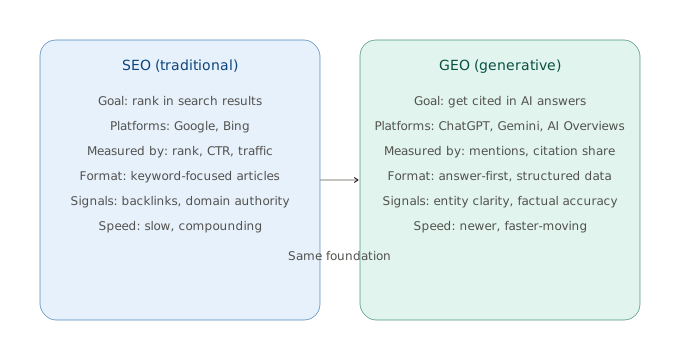
| Factor | SEO (Traditional) | GEO (Generative) |
|---|---|---|
| Goal | Rank in search results, drive clicks | Get mentioned or cited inside AI-generated answers |
| Where it appears | Google, Bing organic results | ChatGPT, Gemini, Perplexity, AI Overviews, AI Mode |
| How success is measured | Rank position, organic traffic, CTR | Brand mentions, citation share, prompt visibility |
| Content format | Keyword-focused, long-form articles | Answer-first, structured, extractable data |
| Ranking signals | Backlinks, domain authority, on-page SEO | Entity clarity, factual accuracy, source credibility |
| Speed of results | Slow, long-term compounding | Newer field, faster-moving, less predictable |
Here’s the important nuance: these two disciplines aren’t competitors — they reinforce each other. Brands that already perform well in traditional search tend to perform better in AI search too, because many AI models still rely heavily on search engine results as an input for training and real-time sourcing. A strong organic position is, in a very real sense, a head start on AI visibility.
GEO vs SEO for Kolkata Businesses: Do You Need Both?
There’s no single answer here — it genuinely depends on your business type. Based on real client work, here are three broad categories.
For Local Service Businesses (Restaurants, Clinics, Real Estate, Salons)
If your business is a restaurant on Park Street or a clinic in Salt Lake, your priority is still overwhelmingly local SEO. Google Business Profile optimization, review management, and “near me” keyword targeting remain the biggest drivers of new customers. GEO plays a supporting role here — because people increasingly ask ChatGPT or Gemini things like, “What’s a good authentic Bengali restaurant in Kolkata?” — and for your name to surface there, your online presence, review volume, and entity data need to stay consistent everywhere.
For E-commerce and Online Stores
E-commerce needs both equally, but GEO’s importance is growing fast here. Industry data shows that nearly all AI Overview-triggering queries are informational in intent — things like “which brand of running shoes is best” — and these research-stage queries are exactly the ones that lead to purchase decisions later. That makes comparison content, “best X for Y” guides, and structured product data increasingly critical for GEO. At the same time, don’t drop traditional e-commerce SEO — category page optimization, product feed hygiene, and page speed still drive the actual transaction-stage traffic.
For B2B and Professional Services
B2B buyers now research far more extensively before making a decision, and a growing share of that research happens inside AI chatbots. If you’re a consultant, agency, or software service provider, GEO matters almost as much as SEO — because decision-makers are directly asking things like “what’s the best digital marketing agency in Kolkata?” and if the AI’s answer doesn’t include your name, you’re losing an entirely new lead channel you may not even know exists.
How AI Search Is Reshaping Consumer Behavior in Kolkata
Kolkata’s middle-class and younger consumer segments are going digital-first fast, and AI tool adoption is keeping pace. A few things stand out:
- India is now one of the largest markets for both ChatGPT and Gemini, with monthly user numbers climbing steadily
- A large share of AI Mode’s user base comes from the US and India combined, showing Indian users are adopting this new search experience relatively quickly
- Consumer trend research shows that most users report positive emotions — satisfaction, relief, confidence — when making shopping decisions with the help of generative AI, suggesting this habit isn’t a passing phase but something that will deepen over time
The practical implication: businesses that get their content, reviews, and entity data AI-ready now will have a meaningful competitive edge over the next two to three years — much like businesses that got their mobile SEO sorted early back in 2015-16 pulled ahead of competitors for years afterward.
How to Start Winning at Both SEO and GEO
Here are the steps that actually get applied in real client work — not theory, practical execution.
1. Structure Content to Answer First
Give a direct answer in the first two to three sentences of every section, then expand with detail. Both AI models and featured snippets favor this “answer-first” format. Open each section by rephrasing the question being asked, then deliver a specific, concise answer — this is the single most effective format right now.
2. Build Entity Authority
AI models recognize you as an “entity,” not just a domain name. Your brand name, location, certifications (Google Partner, Meta Business Partner, etc.), and specialization should appear consistently across your entire website. The more consistent and repeated these signals are, the easier it is for an AI model to recognize and trust you.
3. Show Clear Authorship and Real Experience
Per Google’s recent core updates, having a clear, credible author attached to every article now matters far more than before. Information alone isn’t enough — add real usage experience, personal observations, and case studies. If you’re using AI tools to draft some of your content, layer in human review and genuine insight — mass-produced, unreviewed AI content is a much bigger risk now than it used to be.
4. Use Schema Markup
FAQ Schema, LocalBusiness Schema, and Review Schema help both search engines and AI models parse your content in a machine-readable format. This sounds technical, but it’s straightforward to implement on WordPress with the right plugin.
5. Add Specific Data, Not Generic Claims
Skip vague statements like “we deliver the best service.” Instead, use specific numbers, case studies, and real results. AI models treat content with verifiable, specific information as significantly more trustworthy.
6. Refresh Old Content Regularly
Google’s helpfulness signal now works site-wide — meaning weak pages can drag down rankings across your entire site. So alongside publishing new content, refresh older pages regularly. Multiple industry studies have found that refreshed content often outperforms newly published content in terms of traffic gains.
7. Track AI Citations Manually
Google Search Console alone won’t cut it anymore. Regularly go into ChatGPT, Gemini, and Perplexity and ask questions relevant to your industry. Check whether your brand comes up, and see how competitors are being represented. This manual audit is currently the most accessible way to measure GEO performance.
Quick Self-Check: Is Your Site Ready for GEO vs SEO in 2026?
Ask yourself these questions:
- Does every core service page have a clear, concise answer paragraph that could be lifted and used directly?
- Does your website have an FAQ section, and is it backed by proper Schema markup?
- Is your brand name, address, and certification information written identically everywhere — your website, Google Business Profile, and social media?
- Does your content include real case studies, specific numbers, or verifiable client results?
- Have you personally searched for your own business on ChatGPT or Gemini in the last month?
If most of these come back “no,” that’s exactly where your strategy should start.
Platform-Specific GEO Strategy — Not All AI Models Behave the Same
A common mistake is treating every AI platform the same way. In reality, sourcing behavior differs significantly across platforms, so while a unified strategy works as a foundation, some platform-specific adjustments make a real difference.
Google AI Overviews and AI Mode
Since these features sit directly inside Google Search, they correlate most closely with your existing organic rankings. Industry data shows that a shrinking share of AI Overview citations now come from pages that also rank in the traditional top 10 organic results — a share that used to be much higher. That means strong organic rankings alone are no longer sufficient; the specific content section itself needs to be genuinely extractable.
ChatGPT and Perplexity
These platforms lean heavily on real-time web sourcing and frequently pull from third-party review sites, forums, and community platforms. Multiple citation analyses show that platforms like Reddit, YouTube, and Wikipedia get cited at disproportionately high rates. That means optimizing only your own website isn’t enough — maintaining an active, credible presence on the third-party platforms where your brand gets discussed is now a core part of GEO.
The Gemini App
Gemini’s own user base is growing fast, and it’s tightly integrated with Google’s broader ecosystem — Search, Android, Workspace. So optimizing for Gemini overlaps heavily with traditional Google SEO — if your Google Business Profile, reviews, and structured data are solid, that benefits Gemini visibility too.
A Realistic 3-6-12 Month Roadmap
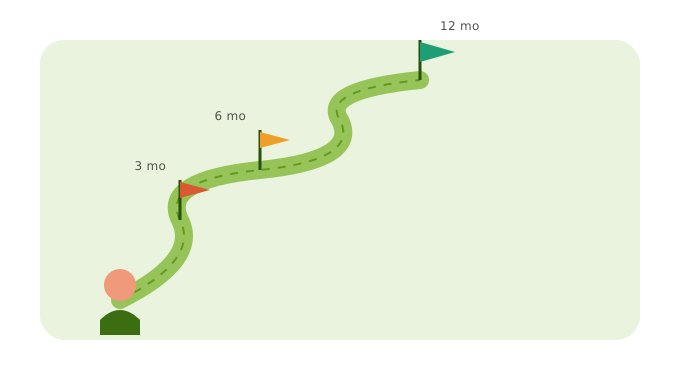
Many business owners ask the same follow-up question: “Okay, I get it — but where do I actually start, and in what order?” Here’s a realistic timeline that works well for small and mid-sized businesses.
- Months 1-3 — Foundation: Run a technical SEO audit, fix Core Web Vitals, fully update your Google Business Profile, and add answer-first formatting plus FAQ Schema to your five to ten most important pages.
- Months 4-6 — Content Expansion: Publish regularly, embed real data and case studies in every piece, refresh underperforming older pages, and build presence on third-party platforms — Google Reviews, industry forums, YouTube.
- Months 7-12 — GEO Optimization and Tracking: Regularly search for your own brand across AI platforms to track citations, create specific new content for the questions where you’re not showing up, and benchmark your AI visibility against competitors to close gaps.
Why Most Kolkata Businesses Are Still Behind on GEO vs SEO
Honestly, most small and mid-sized businesses in Kolkata — and across India — aren’t even aware GEO exists yet as a discipline. A few reasons explain why.
First, many still think of Google as the only search channel, and view ChatGPT or Gemini purely as “content-writing tools.” That’s a significant misconception — the same tools are now used by millions of people to directly discover products, services, and local businesses.
Second, GEO reporting is still genuinely complex. There’s no Google Analytics-style dashboard standardized for AI citations yet, so many agencies and business owners write it off as “unmeasurable” and move on.
Third, most agencies are still locked into the old SEO playbook, and genuine GEO expertise remains rare. That’s actually the opportunity — the business that closes this gap first gets a clear competitive advantage over the next few years, much like the businesses that built mobile-optimized websites early benefited disproportionately once mobile search took off.
A Real-World Example — How a Local Business Could Benefit from GEO
Picture a boutique furniture store in Gariahat. Traditionally, they’d chase keywords like “Kolkata furniture store” or “sofa set Kolkata” — high-competition terms with fierce rivalry. But now, a potential customer is more likely to ask ChatGPT or Gemini something like, “Where can I find a compact sofa for a small flat that delivers in Kolkata?” — an entirely different kind of query: far more specific, and with much less competition.
If that store’s website has a clear, data-rich guide titled something like “Best Compact Furniture Ideas for Small Flats” — with dimensions, pricing, and delivery-area details spelled out clearly — an AI model is far more likely to treat that content as answerable. That’s the real power of GEO: without a massive budget, just by creating the right kind of content, a business can tap into a new, lower-competition channel for leads.
Mistakes to Avoid When Starting with GEO

- Keyword stuffing — AI models parse natural language, so artificially inserted keywords are easier to detect than ever and actively hurt content quality
- Ignoring foundational SEO to chase AI-only tactics — since much of AI sourcing still relies on traditional search, a GEO strategy without a solid foundation won’t hold up long
- Checking once and stopping — AI-generated answers change frequently, so a one-time audit isn’t enough; this needs to be an ongoing process
- Neglecting reviews and third-party presence — focusing only on your own website isn’t enough; presence on the platforms where your brand actually gets discussed matters too
- Not verifying factual accuracy — since Trust is the most important pillar of E-E-A-T, publishing outdated or incorrect information damages long-term credibility
A Quick Glossary of Terms
AEO (Answer Engine Optimization) — A term closely related to GEO, focused mainly on featured snippets and direct question-answering. Many experts consider AEO and GEO functionally the same discipline, differing mostly in naming.
Zero-click search — A search where the user gets their answer directly on the results page and never needs to click through to a website.
Entity — A distinct, recognizable “thing” that an AI model can identify — a brand, a person, a product, or a location.
Citation/Sourcing — When an AI model references or pulls information from a specific website or source in its generated answer.
What SEO and GEO Services Actually Cost — Realistic Expectations
In the Kolkata market, the first question most business owners ask is, “What will this cost?” Scope varies by agency and project, but a few realities are worth understanding.
Traditional SEO usually runs on a monthly retainer model. This often covers technical audits, content production, link building, and reporting.
GEO is still an emerging service category. Most agencies are not selling it as a separate line item yet. Instead, they are folding it into existing SEO or content marketing packages.
That is good news for smaller businesses. It means you do not need a separate large budget to benefit from GEO. Targeted adjustments to your existing content strategy can get you most of the way there.
One important caution: several agencies are now marketing “AI visibility guarantees” or “guaranteed ChatGPT rankings.” In reality, no agency has full control over any AI platform’s internal algorithm, just as nobody can guarantee a #1 Google ranking. Be cautious of these claims, and instead choose a partner that offers a measurable process, regular reporting, and realistic timelines.
How to Tell If an Agency Actually Understands GEO
Since GEO is still a young field, plenty of agencies are using the term as a marketing buzzword without real expertise behind it. Before hiring anyone, it’s worth asking:
- Do they regularly test brand visibility manually across ChatGPT, Gemini, and Perplexity, and show you how they measure it?
- Are they selling GEO as a bolt-on package, or genuinely integrating it into your existing SEO and content strategy?
- Can they give you a specific plan for Schema markup, entity optimization, and E-E-A-T signals — or are they just using buzzwords?
- Do they have real case studies from the Kolkata or broader Indian market?
GEO vs SEO — The Final Verdict for 2026
If this entire discussion had to be reduced to one point, it would be this: in 2026, a Kolkata business’s real question should not be “SEO or GEO.”
Instead, ask: “How are my customers searching for information right now?”
Then ask another question: “Is my content showing up everywhere they are looking?”
That includes Google’s traditional search results, as well as conversational AI platforms like ChatGPT and Gemini.
Frequently Asked Questions
Is GEO vs SEO even the right question to ask in 2026?
Not really. GEO isn’t replacing SEO — it’s extending it. Traditional search results remain the largest traffic source across most industries, and a strong SEO foundation frequently supports AI visibility too, since many AI models use search results as an input when generating answers.
How long does it take to see results from GEO?
Since this is still a relatively new field, there’s no fixed timeline. Generally, consistent, data-rich, well-structured content starts showing early results within a few months of publication — much like traditional SEO, this is a long-term, compounding process.
Can a small Kolkata business afford to invest in both SEO and GEO?
Yes. Since most of GEO’s work involves better-structuring existing content and cleaning up entity data, it can be integrated into an existing SEO strategy without requiring a separate large budget.
Which platforms does GEO actually target?
GEO primarily targets generative AI platforms like ChatGPT, Google Gemini, Perplexity, Claude, and Google’s own AI Overviews and AI Mode — anywhere a user asks a direct question and receives a synthesized answer rather than a list of links.
How are Google’s 2026 core updates affecting GEO?
The 2026 core updates have placed significantly more weight on the “Experience” component of E-E-A-T, meaning content demonstrating genuine, first-hand experience is now outperforming comprehensive-but-impersonal content. These same signals matter for AI models too, which is why the line between SEO and GEO keeps blurring rather than growing further apart.
This article was written by the SEO team at 99Digital Service, which has spent over 15 years helping businesses across Kolkata and India improve their search visibility. For a custom SEO and GEO strategy for your business, reach out at +91 7980256386.
