
If you own a shop on Gariahat, a clinic in Salt Lake, or a restaurant near Park Street, AI search optimization for local businesses in Kolkata is probably something you’ve already brushed up against without knowing its name. You search for “best biryani near me” or “AC repair Behala,” and instead of the usual 10 blue links, a written answer appears at the top, naming two or three businesses. That’s AI search, and it has quietly become the new front door to local customers.
This shift is exactly why AI search optimization for local businesses in Kolkata has stopped being a nice-to-have and turned into something owners genuinely need to understand. Traditional local SEO isn’t dead, but it’s no longer the whole story. AI Overviews, ChatGPT recommendations, and Google’s Gemini-powered search results now decide which businesses get named out loud and which ones simply get skipped. If you’re not structured for that, you can rank on page one and still lose the customer to a competitor who got mentioned in the AI answer instead.
In this guide, we’ll break down what AI search actually is, how it specifically picks local businesses in Kolkata, and what you need to do, step by step, to show up in it. Think of this as a practical playbook for AI search optimization for local businesses in Kolkata, not another theory-heavy article. No jargon for the sake of jargon. Just what actually moves the needle.
What Is AI Search & Why It Matters for Kolkata Businesses
AI search is the layer of Google (and other tools like ChatGPT, Perplexity, and Gemini) that reads through websites, reviews, and business listings, then generates a direct written answer instead of just linking out. When someone in Kolkata types “best dermatologist near Ballygunge” or “affordable digital marketing agency in Kolkata,” the AI Overview tries to answer the question on the spot, often naming specific businesses with a short description.
Here’s the part that catches most business owners off guard: getting the AI to mention your business isn’t the same skill set as getting a page-one ranking. A business can rank third on Google’s traditional results and still be the one the AI picks, because the AI cares more about whether your content directly and clearly answers a question than about backlink count alone.
For Kolkata businesses, this matters for a very practical reason. Local search behavior here is heavily mobile-first and voice-influenced, especially among younger customers in areas like New Town and Salt Lake Sector V who search on the go between meetings. When someone asks their phone “where can I get furniture repaired near me,” the answer that gets read out loud, or shown at the top, wins the customer. Everyone else becomes invisible, no matter how good their actual service is.
So what is AI search optimization for small businesses, in plain terms? It’s the practice of structuring your online presence, your website, your Google Business Profile, your reviews, so that AI systems can confidently understand what you do, where you do it, and why you’re trustworthy enough to recommend.
How Google AI Overviews Select Local Businesses
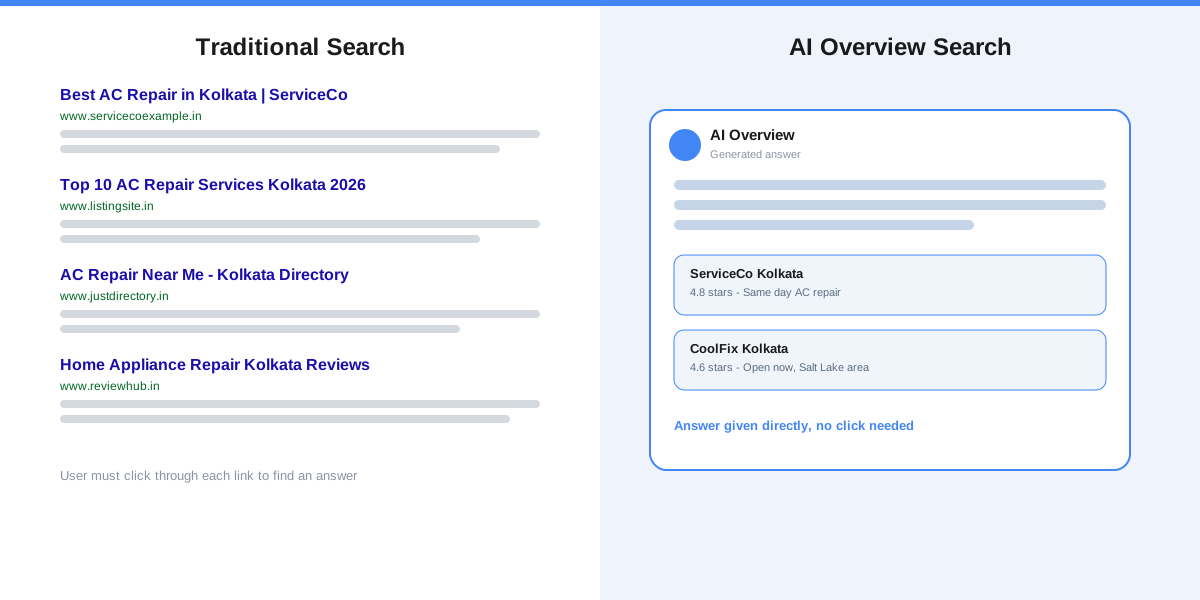
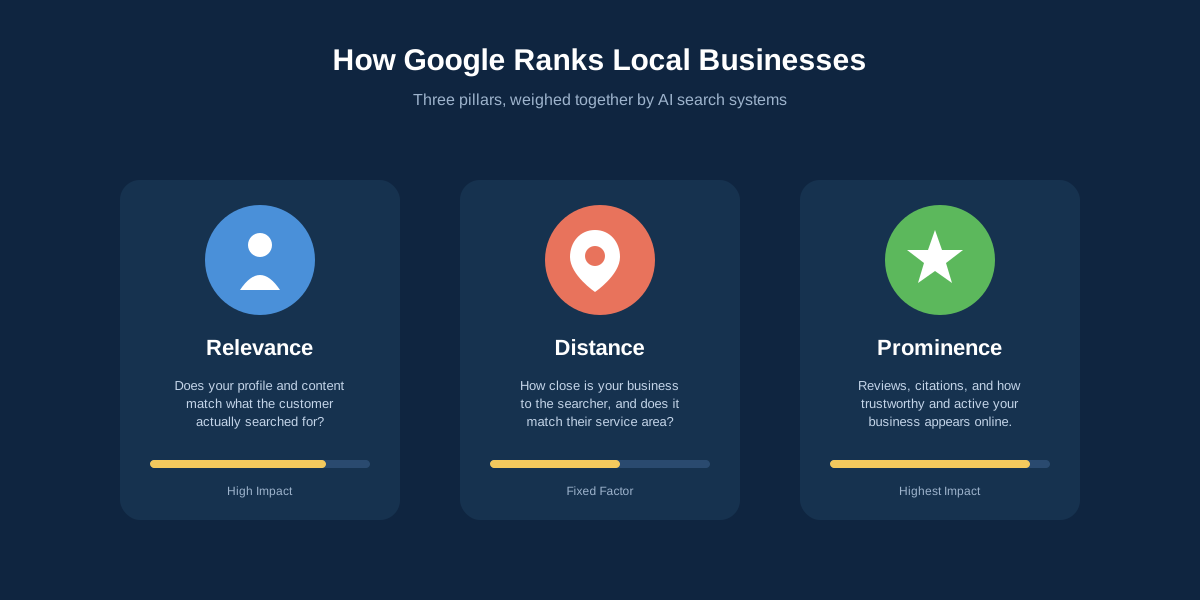
This is where a lot of confusion comes from. People assume AI Overviews use a completely separate ranking system. They don’t, not entirely. Google’s AI still leans on the same three pillars it has always used for local search: relevance, distance, and prominence. What’s changed is how much weight AI adds on top of those basics, and how much faster things move now.
Relevance
Relevance is about how closely your business profile and website content match what the searcher actually typed. If your Google Business Profile says “restaurant” but your website never mentions the specific dishes people search for, like “best mutton biryani in Kolkata” or “authentic Bengali thali near Gariahat,” the AI has nothing concrete to pull from.
Distance still matters, but it’s evaluated more intelligently now. If someone searches “vegan bakery open now near me” in Kolkata, Google’s AI will surface a business that matches on hours and services, even if a closer competitor exists but happens to be shut.
Prominence
Prominence, sometimes called popularity, is where most Kolkata small businesses lose ground. This covers your review volume, review recency, citation consistency across directories, and how often other trustworthy sources mention your business. AI systems tend to cross-check your website against your Google Business Profile, review platforms, and even social media before deciding you’re worth naming. If your business name is spelled one way on your website and another way on JustDial or Facebook, that inconsistency chips away at trust scores.
There’s also a newer layer: behavioral signals
Click-through rates, how long people stay on your site after clicking, and how often people search for your brand name directly. These all feed into how “real” and “active” your business looks to the algorithm. A profile that hasn’t been touched in two months, no new photos, no posts, no responses to reviews, starts looking dormant, and dormant businesses get quietly pushed down.
Key Ranking Factors for AI Search Results
If you want a working checklist, here’s what actually carries weight for AI search visibility right now.
Google Business Profile completeness
This is still the single biggest lever for local visibility. Every field matters: business category, services list, hours, service areas, photos, and a description written in plain language that mirrors how customers actually search.
Review quality and velocity
It’s not just about having a lot of reviews. AI systems read the actual text of your reviews to extract themes, such as “great with kids,” “fast service,” and “genuine Bengali flavors,” and use that language when generating answers. A business with 40 recent, detailed reviews often beats one with 300 old, generic ones.
NAP consistency
Your Name, Address, and Phone number need to match exactly across your website, Google Business Profile, JustDial, Facebook, and any local directories. Even small inconsistencies, like “Salt Lake Sector 5” versus “Salt Lake Sec V,” can create confusion for AI systems trying to verify you’re a real, stable business.
Schema markup
This is the technical part most Kolkata small businesses skip entirely, and it’s costing them. LocalBusiness schema, FAQ schema, and Review schema give AI a clean, machine-readable summary of who you are and what you offer, instead of forcing it to guess by scanning paragraphs of marketing copy.
Content that directly answers questions
AI Overviews pull from content that gives a clear, self-contained answer to a specific question. A page that says “call us for pricing” loses to a competitor’s page that states the actual price range for a service in Kolkata.
Topical authority
A business that has published content answering many related questions in its category looks more credible to AI systems than one with a single generic services page.
Website technical health
If your site is slow, blocks crawlers accidentally, or throws errors, none of the above matters. AI simply can’t read what it can’t access.
AI SEO vs Traditional Local SEO
People often ask if AI SEO replaces traditional local SEO. It doesn’t, and honestly, treating them as separate strategies is a mistake that’s already costing businesses visibility.
Traditional local SEO focuses on keyword rankings, backlinks, and getting your business to appear in the top three of the map pack. AI search optimization builds on that same foundation but adds a layer focused on clarity and direct answers. Think of traditional SEO as building the house, and AEO (answer engine optimization) as making sure the house has clear signage that tells visitors exactly what’s inside.
The practical difference shows up in how you write content. Traditional SEO content often buries the answer inside long introductory paragraphs, written partly to satisfy search engines with keyword density. AI-friendly content puts the answer in the first two or three sentences, then expands with detail afterward. Google has said plainly that the fundamentals of good SEO still apply to AI features, but the businesses winning citations right now are the ones structuring content for direct extraction, not just for keyword matching.
There’s also a mindset shift worth naming. In traditional SEO, the goal was clicks. In AI search, a huge share of searches end without any click at all; the user gets their answer and takes action, calls, visits, or walks in, without ever touching your website. That means being the named business inside the AI answer can matter more than winning a click that might not come anyway.
Step-by-Step Guide for Kolkata Local Businesses
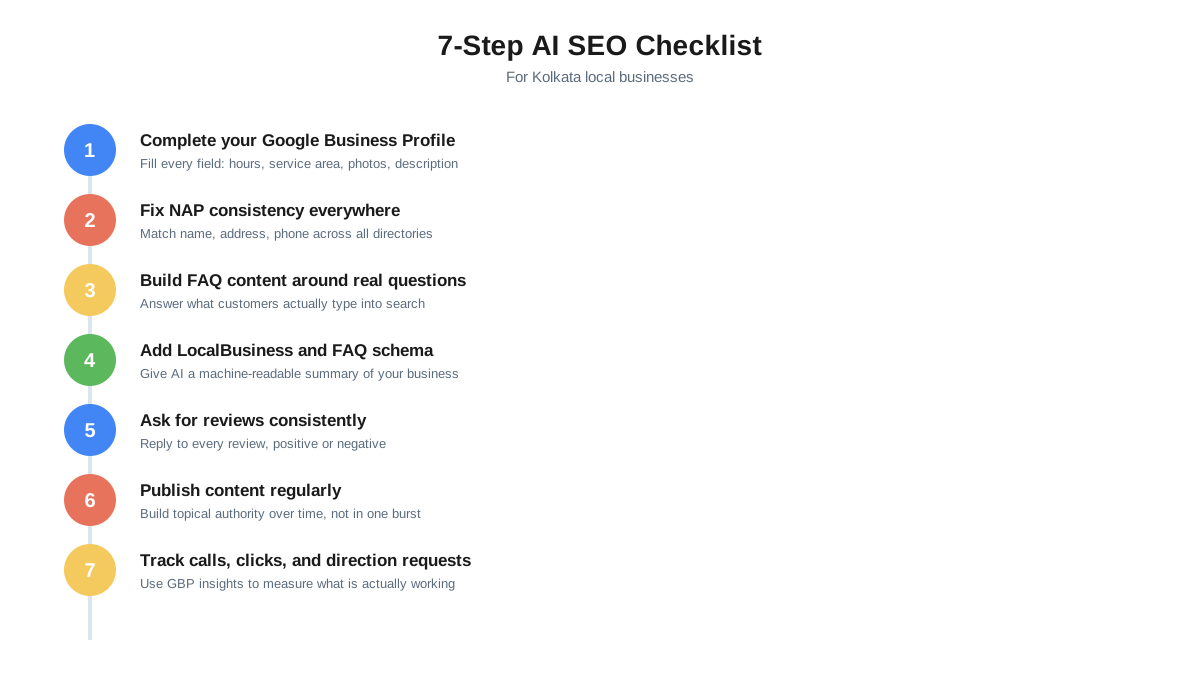
Here’s a practical sequence, roughly in order of impact versus effort, for any local business in Kolkata trying to actually rank in AI search results in Kolkata.
Step 1: Audit and complete your Google Business Profile
Fill in every field. Add your actual service area (not just “Kolkata” broadly, but the neighborhoods you genuinely serve, like Behala, Dum Dum, or Rajarhat). Upload real photos of your storefront, staff, and products, not stock images.
Step 2: Fix your NAP across every platform
Go through Google, JustDial, Facebook, Sulekha, and your own website. Make sure the business name, address, and phone number are identical, character for character, everywhere.
Step 3: Build FAQ-style content around real customer questions
Think about what people in Kolkata actually type before choosing a business like yours: “how much does AC servicing cost in Kolkata,” “is home delivery available near New Town,” “do you accept card payments.” Answer each one directly, in plain sentences, near the top of a dedicated page.
Step 4: Add LocalBusiness and FAQ schema markup to your website
This is a one-time technical task that pays off continuously. If you’re not comfortable doing this yourself, this is exactly the kind of work an experienced local SEO agency for AI search can set up correctly in a day or two.
Step 5: Ask for reviews consistently, and reply to every single one
Not in a bulk push once a year, but as a steady habit tied to every completed job or sale. Owner responses, especially ones that mention specific details from the review, add real trust signals.
Step 6: Publish content regularly, not just once
A single services page won’t build topical authority. Blog posts, service-specific pages, and location pages that genuinely add value over time are what convince AI systems that your business has real expertise, not just a listing.
Step 7: Track what’s actually working
Use Google Business Profile insights and basic analytics to see whether calls, direction requests, and website visits are climbing. Grid tracking tools can also show how your visibility shifts across different parts of the city.
Following even the first four steps consistently puts most Kolkata-based local brands ahead of a majority of local competitors, simply because so few are doing this properly yet.
Common Mistakes That Stop AI Rankings
A few patterns show up again and again when Kolkata businesses struggle to get AI visibility, even after doing “SEO.”
Treating the Google Business Profile as a one-time setup. Filling it in once and never touching it again is one of the fastest ways to look inactive. Profiles that go quiet for a month or more often see a real drop in visibility.
Ignoring reviews, or worse, only replying to negative ones. Silence on positive reviews wastes free trust-building opportunities. AI systems and human customers both notice when an owner engages consistently.
Writing content for search engines instead of people. Stuffing “digital marketing agency in Kolkata” into every other sentence doesn’t help anymore. AI systems favor content that reads naturally and answers the actual question a person has.
Inconsistent business information across platforms. Even small mismatches, a missing suite number, a shortened street name, quietly erode the trust signals AI systems rely on to verify you’re a legitimate, stable business.
Skipping schema markup entirely. Many Kolkata small business websites still have zero structured data. That means AI systems are forced to guess at basic facts they could otherwise read instantly.
Chasing every directory instead of the right ones. More citations aren’t automatically better. A handful of accurate, well-maintained listings on the platforms that matter beats fifty inconsistent ones scattered across low-quality directories.
Future of AI Search for Local Businesses in Kolkata
It’s worth being honest about where this is heading, because the businesses that move early usually keep the advantage longer. AI search optimization for local businesses in Kolkata is still a relatively open field right now, which is exactly why the timing favors whoever acts first. AI Overviews are appearing on a growing share of local and informational searches, and that trend shows no sign of slowing down. As more Kolkata shoppers turn to voice search and AI assistants for quick decisions, “near me searches in Kolkata” will increasingly get answered without a single click on a website.
For local shops in Kolkata, this cuts both ways. It’s a genuine opportunity because ranking in AI search doesn’t require the massive backlink profiles that dominated old-school SEO. A well-structured page from a business with strong reviews and a complete profile has a real shot at getting cited, even without years of domain authority behind it. But it also means businesses that ignore this shift for another year or two may find it much harder to catch up once local competitors have already built that AI trust.
Expect Google Business Profile freshness, review sentiment, and content built specifically to answer questions to keep growing in importance. Expect service providers in Kolkata who invest in this now to become the default names AI tools mention when customers ask for recommendations, and expect that position to be genuinely difficult to dislodge once it’s established.
Entity & Topical Authority Signals AI Systems Trust
There’s one more layer worth understanding before you jump into execution: entity authority. AI systems don’t just read your website in isolation. They try to confirm you’re a real, established business by checking whether other trustworthy sources agree with what you say about yourself.
This is where E-E-A-T signals, experience, expertise, authoritativeness, and trustworthiness, come into play. A dentist in Ballygunge who publishes genuinely useful answers about oral health, has verified credentials listed on their site, and gets mentioned by local health directories looks far more credible to AI systems than one with a bare-bones one-page website.
Local backlinks still matter here too, not for old-school link-building volume, but as a trust layer. A mention from a Kolkata news site, a local chamber of commerce, or a well-known community blog tells AI systems that your business is recognized beyond your own marketing. Similarly, brand mentions, even ones without a clickable link, feed into how confidently AI systems associate your business name with your category and location.
And then there’s content experience: how easy your site actually is to use once someone lands on it. Slow load times, intrusive pop-ups, or a services page buried three clicks deep all quietly undermine the trust signals you’ve built everywhere else. A clean, fast, well-organized site tells both users and AI systems that this is a business worth recommending, not just one that happens to rank.
Put together, local citations, customer reviews, and ratings, NAP consistency, schema markup, and these broader entity signals form the trust layer underneath everything else in this guide. Get the technical basics right, then build this authority layer steadily, and the AI visibility tends to follow.
FAQs (AI Search & AEO for Kolkata Businesses)
How can local businesses rank in AI search results?
Focus on three things at once: a fully completed and actively updated Google Business Profile, consistent NAP information across every platform, and website content that directly answers the specific questions your customers ask, ideally supported by proper schema markup so AI systems can read your business details without guesswork.
Does Google AI Overview replace SEO?
No. Google has stated that standard SEO fundamentals still apply to AI features. AI Overviews build on the same relevance, distance, and prominence signals traditional local SEO has always used; they just add an extra layer that rewards clear, direct, well-structured answers.
Is Google Business Profile enough for AI ranking?
It’s necessary but not sufficient. A complete, active GBP is often the single strongest lever for local visibility, but AI systems also weigh your website content, review quality, and citation consistency before deciding to name your business in an answer.
How long does AI SEO take for local businesses?
Most Kolkata businesses start seeing early movement, more profile views, and more direction requests within four to eight weeks of consistent work. Meaningful AI citation visibility, actually being named in AI Overviews regularly, typically takes a few months of steady effort, since AI systems weigh consistency and freshness over time rather than rewarding a single burst of activity.
Is AI search important for small businesses in Kolkata?
Yes, and arguably more important for small businesses than large ones. AI citation doesn’t require the huge marketing budgets that traditional SEO competition often demanded. A local shop with genuine expertise, real reviews, and a well-structured website can realistically compete for AI visibility against much bigger players, something that was far harder to achieve in the old link-building era of SEO.
Get AI SEO Help in Kolkata with 99digital Service
 If you’ve read this far, you already understand more about AI search optimization for local businesses in Kolkata than most of your competitors do, and that gap alone is worth acting on. The harder part is actually implementing it correctly, auditing your Google Business Profile, fixing NAP inconsistencies across a dozen directories, writing schema markup, and building content that AI systems trust enough to cite.
That’s where 99digital service comes in. We work specifically with Kolkata-based local brands, from neighborhood shops around Gariahat and Behala to growing service businesses in Salt Lake and New Town, helping them get found in both traditional local SEO and the newer world of AI and answer engine optimization. Our approach combines Google Business Profile optimization, local citations cleanup, AEO-focused content writing, and structured schema markup, built around real E-E-A-T signals rather than shortcuts that stop working the moment Google updates its algorithm.
Whether you’re just starting to explore AI SEO services in Kolkata or you’ve already tried local SEO with mixed results, our team can audit where you currently stand and show you exactly which of the steps above will move the needle fastest for your specific business.
Ready to become the business AI actually recommends when your customers search? Reach out to 99digital service today for a local SEO and AI search audit built specifically for your Kolkata business.
About the Author
Year Ali is a Kolkata-based SEO specialist with 8 years of experience in local SEO and AI search optimization. He has helped shops, clinics, and restaurants across the city get discovered online, focusing on practical strategies over jargon-heavy theory. Connect on LinkedIn profile https://www.linkedin.com/in/year-ali-91631a285/
